Summary: Ice fishing in Alberta runs on the 2026 Guide to Sportfishing Regulations, which governs the whole 2026-27 winter through March 31, 2027. You may use two lines through the ice, a resident licence is $30, and the biggest change this year is that walleye Special Harvest Licences are no longer a draw at all, they are first come first served. Two well known lakes, Sylvan and Gull, are closed through all of first ice and only reopen December 11. Burbot drops to a zero limit on many Parkland lakes from February 1. Here is the whole picture, plus the ice thickness numbers that matter more than any of it.
Alberta has roughly 800 lakes that naturally contain fish. For a province this size, that is not many, and it explains almost every restrictive line in the regulations.
Backroad Maps has charted this province for more than 30 years, and winter is when Alberta's fishing rules get most specific and least forgiving. Two lakes an hour apart can have opposite pike limits. A lake that is open in October can be closed in November and open again in December. A species you could keep in January hits a zero limit on February 1.
None of that is arbitrary. As the province puts it, "Alberta has relatively few lakes that naturally contain fish, about 800 in total, which is a very small number compared to other provinces." What follows is how to fish inside those rules and come home.
"Careful measurement of ice thickness is important, always test ice conditions. Never walk on ice that is less than 10 cm (4 in.) thick and do not drive on ice that is less than 30 cm (12 in.) thick." (2026 Alberta Guide to Sportfishing Regulations)
Key takeaways
- Two lines are permitted through the ice, one in open water, and you must stay within 30 metres of any line.
- New for 2026: walleye Special Harvest Licences are sold first come first served, not by draw. Each SHL carries two tags, and you may buy up to six for a maximum of twelve tags.
- Sylvan Lake and Gull Lake close after October 31 and do not reopen until December 11, so first ice on both is closed water.
- Ice shelters left more than 24 hours must be labelled outside in 2.5 cm block letters with your WIN number or name and phone number, and must be off the ice by March 15 in PP1 or March 31 elsewhere.
- Northern pike carry a zero limit on many of the best known lakes, including Lac Ste. Anne, Pigeon, Wabamun, Sylvan, Gull, Lesser Slave and Calling.
How Alberta's system works
Alberta has three Fish Management Zones: "Zone 1 Eastern Slopes, Zone 2 Parkland-Prairie and Zone 3 Northern Boreal." Those split into Watershed Units, ES1 to ES4, PP1 and PP2, and NB1 to NB4. Every unit has default regulations plus a site specific table for listed waterbodies (2026 Alberta Guide to Sportfishing Regulations).
The rule that ends trips before they start: "If a listed waterbody does not have a season listed, it is CLOSED to fishing during that period." Silence is a closure, not a permission.
For winter, the broad picture is this. Default lakes in ES1 to ES4, PP1 and PP2 are open all year. Default lakes in NB1 to NB4 are open May 15 to March 31. Flowing water is largely shut: all four Eastern Slopes units close their streams from November 1, all four Northern Boreal units close streams November 1 to May 31, and only Parkland-Prairie streams stay open through winter.
On top of that there is a specific prohibition worth knowing: you may not fish through the ice "into beaver ponds" or "into flowing waters in ES1 to ES4 management zones", with a single exception for a portion of the Lobstick River. That is echoed in the federal Alberta Fishery Regulations, so it is not a soft rule.
One easy winter option a lot of people overlook: the stocked put and take lakes are "OPEN all year; Bait is allowed; 5 trout of any size; 3 Northern Pike of any size; 15 Yellow Perch of any size." Alberta stocked 2.1 million trout across 268 waterbodies in 2025, and plans roughly 2 million across more than 260 for 2026.
Licences and what they cost
A WIN is required before you buy anything: activation is a one time $12 plus GST, with $2 off if you create or renew it online. Then, per the 2026 fee table:
- Annual sportfishing licence, ages 16 to 64: Alberta resident $30, non-resident Canadian $62, non-resident outside Canada $87.
- Alberta residents 65 and over, and anyone under 16: no licence required.
- 1-day licence, not available to Alberta residents: non-resident Canadian $27, outside Canada $29. 7-day: $43 and $57.
- Special Walleye Harvest Licence: $12, Alberta residents only.
- Canadian Armed Forces veterans who are Alberta residents: no charge.
Licences are available at albertarelm.com or from more than 300 private licence issuers. A reprint is free online or $2 at an issuer, and a lost tag can be replaced for $11.
Two dates for the calendar. Family Fishing Weekend runs February 13 to 15, 2027, when "Albertans and visitors can fish in open waters without a sportfishing licence," although regulations still apply and a licence is still required if you are using a Special Harvest Licence. And a quirk on the Saskatchewan border: "Sportfishing in Cold Lake requires either an Alberta Sportfishing Licence, or a Saskatchewan Angling Licence."
The specific ice fishing rules
These are the ones officers actually check:
- Two lines through the ice. It is unlawful to "Use more than one line when angling into open water. Use more than two lines when angling into ice-covered water."
- 30 metres. Unlawful to "While angling, be further than 30 m from any line in the water." Set a second hole and walk away, and you are offside.
- Three hooks maximum per line, and no hook with more than three points on a common shaft.
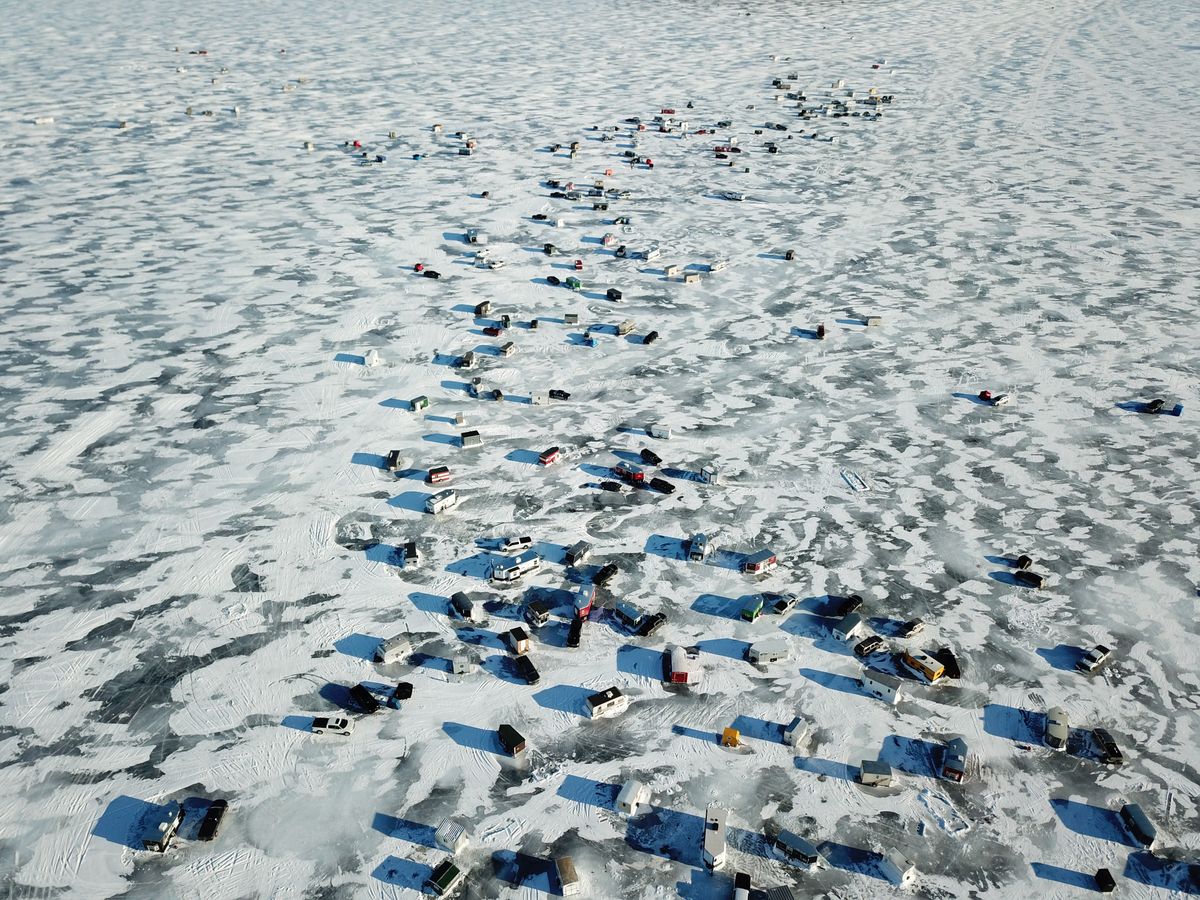
- Shelter identification. "All ice fishing shelters that are on the ice for more than 24 hours must be labelled on the outside with 2.5 cm block letters or larger with WiN number or name and phone number."
- Shelter removal. "Ice fishing shelters must be removed from the ice by March 15 in PP1 and March 31 everywhere else, or when directed to do so by an officer."
- No lights. Unlawful to use lights to fish unless attached to a hook or line, and the Guide is explicit that "This includes visible lights that are emitted by underwater cameras."
On bait, live fish are flatly prohibited, as are amphibians. Dead bait fish are allowed where permitted, from a defined list including suckers, sticklebacks, trout-perch, Iowa darter and minnows, but not carp, goldfish or western silvery minnow. Cisco, also called tullibee, may not be used whole. Where a bait ban applies, only unscented lures are legal, and scented weights are illegal too. There is a smart middle option on some lakes: "only maggots and mealworms may be used as bait to allow anglers to fish for perch and lake whitefish with less impact on pike populations."
One honest gap. We searched the full 112 page Guide and the federal Alberta Fishery Regulations and found no rule anywhere on hole size or auger diameter. That is an absence rather than a stated permission, and a specific lake or park could still carry a posted local restriction, so check the signage where you park.
Limits, and the walleye tag change
Alberta's province wide maximum possession limits, which include fish already in your freezer at home: walleye 3, or up to 12 when harvested under Special Harvest Licences combined with any other licence. Northern pike 3. Yellow perch 15. Lake whitefish and cisco 10 combined. Burbot 10. Lake trout 3, inside an all-trout cap of 5 in total. Bull trout, Arctic grayling and lake sturgeon are all zero.
Now the change. The draw is gone: "For the 2026 angling season, all Special Harvest Licences (Class A, B and C) are available for direct purchase by eligible Alberta resident anglers on a first-come, first-serve basis, until waterbody and/or Class quotas are reached," and "There is no more application and draw process for walleye SHLs." Classes are Class A over 50 cm, Class B 43 to 50 cm, Class C under 43 cm. Each SHL includes two tags, you may buy up to six for twelve tags total, and sales opened April 28, 2026 at 9:00 am MT (MyWildAlberta).
Tagging is physical and must be immediate: a paper tag with wire through the gill cavity and mouth, and the electronic tag pilot "remains paused." Anglers under 16 may use a supervising adult's tags. There are 18 SHL waterbodies for 2026: Amisk, Baptiste, Crawling Valley, Ethel, Fawcett, Gregoire, Hilda, Lac Ste. Anne, Long, Moose, Newell, Pigeon, Seibert, Shiningbank, Wabamun, Wadlin, Whitefish and Wolf.
Alberta is also actively rebuilding stocks: four walleye spawn camps supported stocking in 18 waterbodies in 2025, releasing 25.7 million walleye fry and 6,000 fingerlings, nearly double the fry stocked in 2024. Last season produced 27 new harvest opportunities for walleye and northern pike.
Lake by lake, with the seasons that catch people
No Alberta government source ranks lakes for ice fishing quality. What follows is the verified season and limits for the lakes people actually ask about, and where the traps are.
Sylvan Lake and Gull Lake share the same trap: open May 15 to October 31 and December 11 to March 31. That means both are legally closed from roughly November 1 through December 10, which is exactly first ice. Sylvan is walleye 1, pike 0, perch 5, whitefish 5. Gull is walleye 1 fish 45 to 50 cm, pike 0, perch 5, whitefish 3, and its Diversion Canal is closed all year.
Lac Ste. Anne, open May 15 to March 31: walleye 0 or SHL tags, pike 0, perch 15, lake whitefish 10, burbot 2 but zero from February 1 to March 31. The Alberta Conservation Association separately notes "decent whitefish populations, retain up to 10."
Pigeon Lake, open May 15 to March 31: walleye 0 or SHL, pike 0, perch 5 over 25 cm, whitefish 10, burbot 1 and zero from February 1.
Wabamun Lake, open May 15 to March 31: walleye by SHL tags or one fish 50 to 55 cm, pike 0, perch 0, whitefish 5, burbot 2 and zero from February 1. Class C only for SHLs in 2026. Note that some third party pages still describe Wabamun as catch and release only, which does not match the 2026 Guide. Use the Guide.
Cold Lake, open May 15 to March 31, is the strongest verified winter lake trout opportunity in the province: lake trout 1 fish 65 to 70 cm from May 15 to September 14 and November 16 to March 31, and zero from September 15 to November 15. Also walleye 3 over 50 cm, pike 1 over 63 cm, perch 15, whitefish 10, burbot 10.
Lesser Slave Lake is two lakes as far as the regulations are concerned. The west portion is open June 16 to March 1, and the remainder to the outlet is open May 15 to March 31. Both: walleye 1 fish 45 to 50 cm, pike 0, perch 15, whitefish 10, burbot 10. The west end closing a month earlier is the detail that ruins a March trip.
Calling Lake, open June 1 to March 31: walleye 1 fish 45 to 55 cm, pike 0, perch 15, whitefish 10, burbot 10. Its tributaries and the first kilometre of outlet are closed in winter.
Crawling Valley Reservoir has an unusual and useful rule: open May 8 to November 30 between sunrise and sunset, then "OPEN ALL DAY DEC. 1 TO MAR. 15." Night ice fishing is legal there in winter. Walleye 0 or SHL, Class A and B only, pike 1 fish 63 to 70 cm, perch 15, whitefish 10, burbot 10.
Chestermere Lake, open May 8 to March 15: pike 3 over 63 cm, perch 15. Note the March 15 close and that PP1 is also where shelters must be off by March 15. As a municipal reservoir it may carry city bylaws on ice access that the provincial Guide does not cover, so check locally.
And a genuinely new one: "Northern pike harvest is now permitted at Crane Lake" in NB1, open May 15 to March 31, with pike 1, perch 15 and burbot 10.
Ice safety, with the actual numbers
Two Canadian authorities publish thickness guidance and they do not fully agree, which is itself worth knowing.
The Lifesaving Society Alberta and Northwest Territories, for clear blue or green ice only: 7 cm or less, "STAY OFF". 10 cm, ice fishing, walking, cross country skiing. 13 to 18 cm, one snowmobile or ATV. 20 to 30 cm, one car or a group of people. 30 to 38 cm, one medium truck. Their overarching line is the one to remember: "No ice is without risk" (Lifesaving Society).
The Canadian Red Cross is more conservative: 15 cm for skating, walking or skiing in small groups, 20 cm for larger groups, and 25 cm for snowmobiles or ATVs. It also states flatly that "There is no such thing as 100 percent safe ice," that "Blue ice is the strongest, while grey ice is unsafe," and that you should "Avoid ice that has recently frozen, thawed, and then frozen again" (Canadian Red Cross).
Where they agree completely is on what weakens ice: current and moving water, springs, snow cover that prevents complete freezing, pressure ridges, dark objects absorbing heat, fluctuating water levels, and the early and late season freeze-thaw cycle. The Alberta Guide says the same in one sentence: "Ice can vary in thickness and in strength from area to area because of temperature, water current, springs, snow cover and time of year."
Three practical rules from the province: do not drive fast, follow closely behind, or park near another vehicle on the ice. Ask someone who knows the area about conditions and places to avoid. And stay well away from aeration sites, because aerators produce unpredictable thin ice and open water, and being familiar with a lake in a previous winter tells you nothing about this one.
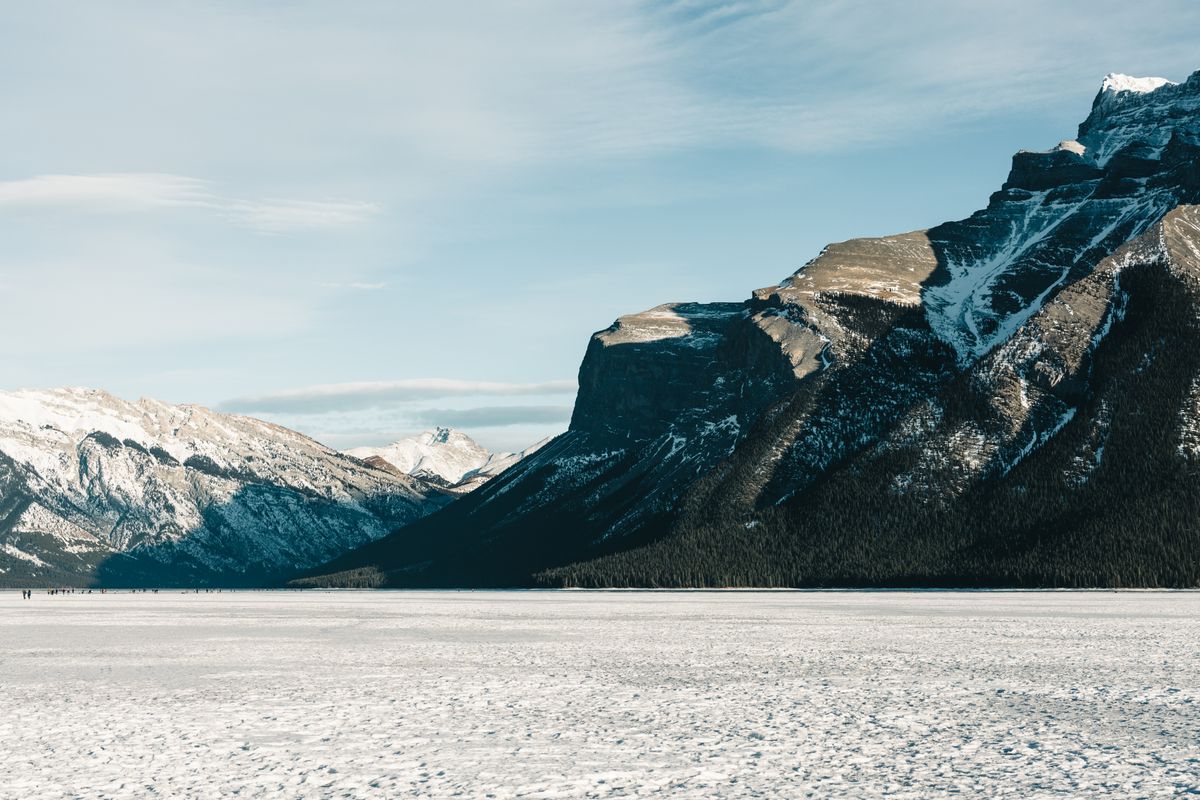
Getting there, and knowing what is under you
Half of Alberta ice fishing is a winter road problem. The lake is open, the limit is clear, and the question is whether you can reach the good end of it.

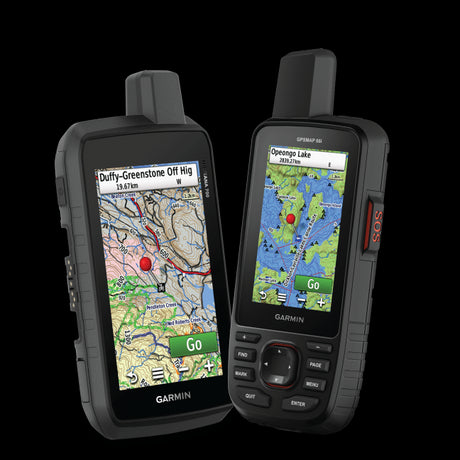
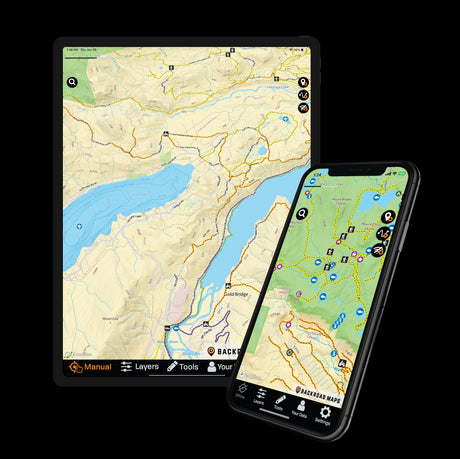
The winter layer and lake depth charts in the BRMB Maps app do two jobs here: they show winter access routes and road classification so you know what your truck can handle, and the bathymetry tells you where the drop-offs and shoals are before you drill a single hole. On a big lake in a cold wind, choosing the hole from a chart rather than by walking is worth the whole trip.
On access rules: inside a provincial park or provincial recreation area, you may not operate a motor vehicle except on a highway or with written Ministerial authorisation, and OHVs are restricted to designated trails. The Guide states that "Off-highway vehicle (OHV) access is prohibited in most provincial parks and provincial recreation areas." Outside parks, every OHV needs valid registration and insurance, a visible plate, working head and tail lights, a muffler and a spark arrestor, and a CSA compliant helmet. Riders under 14 need adult supervision.
For snow vehicles there is a specific rule about the lake itself: "Keep tracks out of the water. Tracked vehicles are not allowed on the bed or shore unless the travel is on frozen ground without making a depression, or on ice capable of holding the weight of the snow vehicle without breaking."
An honest note on driving a truck onto lake ice. Inside a provincial park it is prohibited without authorisation. Outside parks we could not find an Alberta statute that either authorises or prohibits it, so we are not going to tell you it is legal or illegal province wide. What the province does say is do not drive on ice under 30 cm.
If you are camping the trip, a Public Lands Camping Pass is required year round to random camp along the Eastern Slopes, $20 per person for three days or $30 annually, and there is a 14 day limit in one spot before you must move at least 1 km for 72 hours. A Kananaskis Conservation Pass is required for vehicles parked in Kananaskis Country and the Bow Valley. Fishing is prohibited outright in Wilderness Areas and Ecological Reserves.
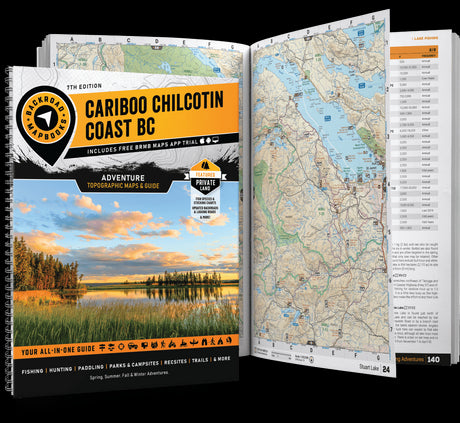
Scout winter access, lake depth and public land boundaries on BRMB's Alberta layers before you leave the pavement, and carry the Alberta Backroad Mapbook bundle as the paper backup. For public land questions and closures, 310-LAND runs 24 hours a day.
FAQ
How many lines can you use ice fishing in Alberta?
Two through the ice, and one in open water. You must also stay within 30 metres of any line, and no line may carry more than three hooks.
What does an Alberta fishing licence cost for 2026-27?
$30 for an Alberta resident aged 16 to 64, $62 for a non-resident Canadian and $87 for a non-resident from outside Canada. A WIN activation is a one time $12 plus GST, with $2 off online. Residents under 16 and 65 and over need no licence.
Do you still need to enter a draw for walleye tags in Alberta?
No. For 2026, all Special Harvest Licences are sold first come first served to eligible Alberta residents until quotas are reached. Each SHL is $12 and carries two tags, and you may buy up to six.
How thick does the ice need to be in Alberta?
The province says never walk on ice less than 10 cm thick and never drive on ice less than 30 cm thick. The Lifesaving Society gives 10 cm for walking and ice fishing, 13 to 18 cm for one snowmobile or ATV, and 20 to 30 cm for one car. The Canadian Red Cross is more conservative at 15 cm for walking and 25 cm for a snowmobile.
When do ice shelters have to come off the ice in Alberta?
March 15 in PP1 and March 31 everywhere else, or sooner if directed by an officer. Any shelter left on the ice more than 24 hours must be labelled outside in 2.5 cm block letters with your WIN number or name and phone number.
Wrap up
Alberta ice fishing rewards people who read the table for the specific lake, not the general rule. Check the season, because Sylvan and Gull are closed for all of first ice. Check the species, because pike is zero on most of the famous Parkland lakes. Check the date, because burbot goes to zero on February 1 in a long list of waters. And if you want walleye in the freezer, buy the tags early now that the draw is gone.
Then respect the ice. Measure it, avoid current and springs and aerators, and remember that no ice is without risk. Scout winter access, depth contours and public land boundaries on BRMB Maps, then download the area for offline use, a PRO feature, because the parking spot at the good end of the lake is usually past the last bar of service. Start planning on the BRMB Maps Explore Canada hub.